

Most independent café owners manage more vendor relationships than they need to and pay for it in ways that don't always show up on a single invoice.
The cold brew program is often where the hidden costs live. Between the supplier delivering pre-nitrogenated product, the CO₂ vendor, the water delivery service, and the equipment maintenance contract, a single beverage category can involve four or five separate invoices, four or five separate schedules, and four or five separate relationships to manage.
This is the vendor math most café owners never actually sit down and run. Here’s what it looks like when you do.
The Vendor Math Most Café Owners Never Run
Take a mid-volume independent coffee shop doing a solid nitro cold brew program. On any given week, the beverage operation might involve:
- A cold brew supplier delivering pre-nitrogenated product on a fixed schedule
- A CO₂ or nitrogen vendor for carbonation and infusion
- A water delivery service for still and sparkling
- An equipment maintenance contract for the dispensing system
Each of these is a separate vendor relationship. Each has its own invoice, its own delivery window, its own point of contact when something goes wrong. Individually, none of them feels like a big deal. Together, they represent a significant operational overhead that has nothing to do with making great coffee.
The more important number is what happens when one of those relationships breaks down. A delayed delivery of pre-nitrogenated cold brew doesn’t just mean a late shipment — it means the nitro menu is off until the next delivery window. A guest who came in for a nitro cold brew and left with a regular iced coffee is not a satisfied guest. And a guest who came back three times to find the nitro was unavailable is probably not coming back a fourth time.
The hidden cost of vendor complexity isn’t just money. It’s the hour a week chasing invoices, the Saturday service call you didn’t budget for, and the menu item you can’t reliably serve.
What Inconsistent Nitro Actually Costs You
Inconsistent product quality is one of the hardest costs to quantify — because it doesn’t show up on an invoice. It shows up in repeat visit rates.
Nitro cold brew is a premium product. Guests who order it expect a specific experience: the cascading pour, the creamy mouthfeel, the visual drama of nitrogen moving through dark liquid. When that experience is inconsistent — flat one day, perfect the next, unavailable the week after — the premium doesn’t hold.
For a coffee shop where regular customers account for the majority of revenue, the math on repeat visits matters more than the margin on any single drink. A guest who builds a daily nitro habit is worth significantly more than the $6.50 on the ticket. A guest who stops building that habit because the product isn’t reliable is a compounding loss.
The operators who run the most consistent nitro programs aren’t necessarily the ones with the best recipe. They’re the ones whose equipment delivers the same result every time, regardless of who’s behind the bar or what the delivery schedule looks like that week.
The ProFusion System: Still and Nitro from One Keg
The Crysalli ProFusion system addresses the delivery dependency problem at the equipment level. Instead of relying on pre-nitrogenated cold brew from a specialty supplier, the system injects nitrogen directly at the point of dispensing — which means any regular cold brew, from any supplier, can be served as a perfect nitro pour.
The practical implication: the café keeps its existing cold brew supplier relationship (or switches to a less expensive, more widely available regular cold brew), eliminates the nitrogenated product vendor, and gains flexibility in sourcing. Regular cold brew is cheaper, more available, and has more flexible delivery options than pre-nitrogenated product. The nitrogen infusion happens at the tap, not at the supplier.
Dual-style dispensing from a single keg
The ProFusion system’s dual-style capability means a single keg of cold brew produces both still cold brew and nitro cold brew from the same tap. This is a meaningful operational simplification: one product in the keg, two menu items available, no switching between setups during service.
For a coffee shop where counter space is real estate, a compact footprint that delivers two products is a material advantage over a configuration that requires separate equipment for each format.
Consistent output regardless of operator
The system is designed for consistent nitrogen infusion across every pour — the first drink of the morning and the last one of the night perform identically. For operations with variable staffing or high turnover, equipment that removes the human variable from product consistency is a training and quality control advantage.
What 25 Nitro Pours Per Day Looks Like on Your P&L
The margin comparison between iced cold brew and nitro cold brew is where the business case becomes concrete.
| Beverage | Avg. Menu Price | Est. Cost | Gross Profit | Margin |
|---|---|---|---|---|
| Iced Cold Brew | $5.00 | $1.50 | $3.50 | 70% |
| Nitro Cold Brew | $6.50 | $1.70 | $4.80 | 74% |
| Nitro cold brew generates 30–50% more revenue per cup than iced cold brew — from the same keg. | ||||
The difference between 70% and 74% margin may not sound dramatic. The annual revenue difference is what changes the conversation.
| Daily Nitro Pours | Annual Gross Profit | What That Means |
|---|---|---|
| 25 pours/day | $43,000+ | Typical independent café, moderate nitro volume |
| 50 pours/day | $86,000+ | High-volume café or multi-tap setup |
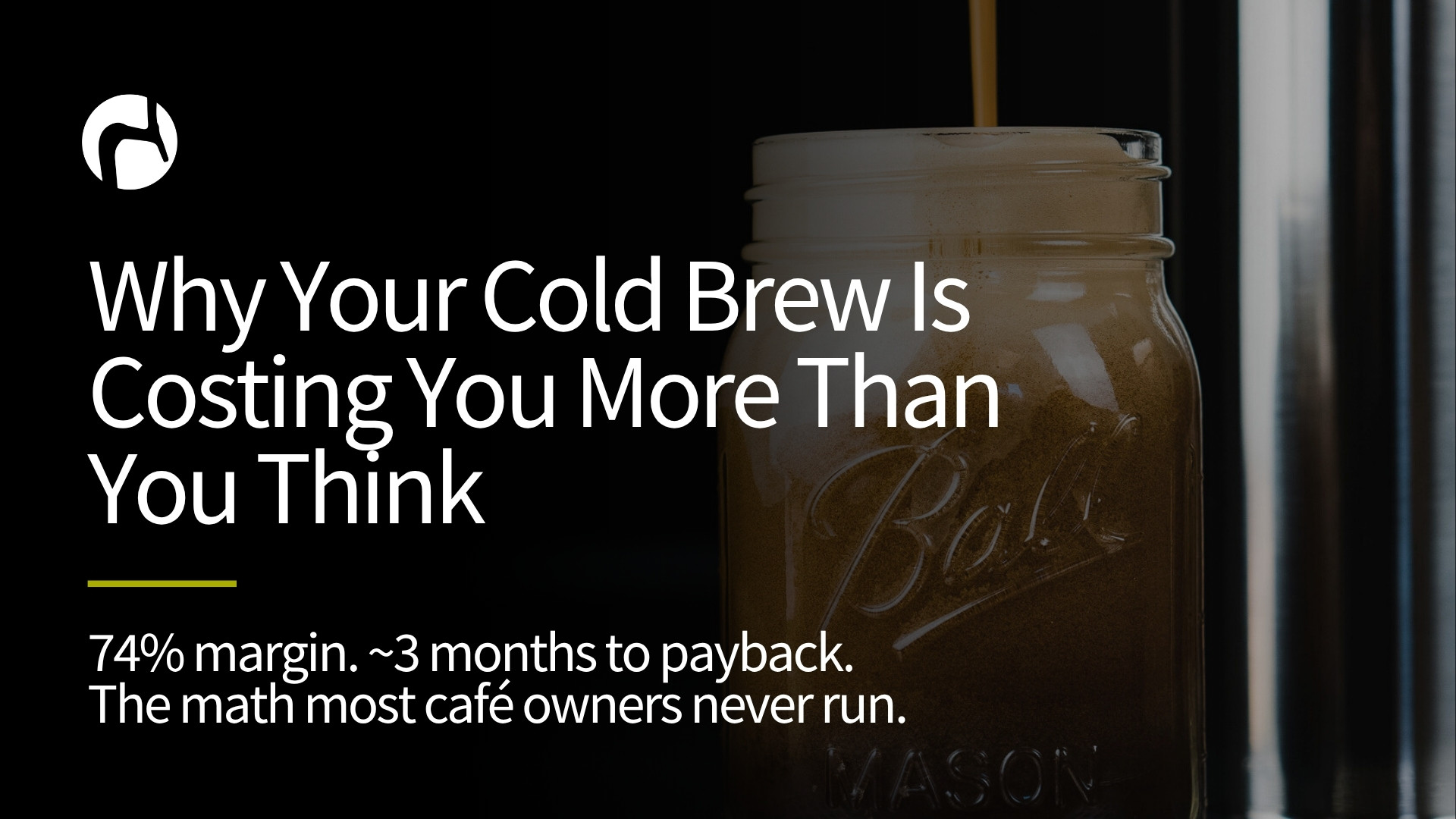
At an approximate installed investment of $12,000, a café serving 25 nitro pours per day reaches break-even at roughly 2,500 drinks — approximately three months of normal operation. After that point, the system is generating incrementally higher-margin revenue from every pour compared to what the iced cold brew alternative would have produced.
| Approx. Investment | Break-Even Point | Payback Period |
|---|---|---|
| ~$12,000 installed | ~2,500 drinks | ~3 months at 25 pours/day |
| Most systems pay for themselves before the end of the first quarter of normal operation. | ||
Nitro cold brew generates 30–50% more revenue per cup than iced cold brew — from the same keg. The equipment pays for itself in approximately three months at 25 pours per day.
The operators making this work are not high-volume specialty outliers. They are independent cafés doing normal business with one piece of better equipment — and a beverage program that doesn’t depend on a delivery window showing up on time.
Frequently Asked Questions
These are the questions coffee shop owners most commonly ask before making a decision on nitro equipment. Each answer is written to give you the information you need to evaluate independently.
A Crysalli ProFusion system runs approximately $12,000 installed, which includes the equipment and installation support. At 25 nitro pours per day, the system reaches break-even in approximately three months. At 50 pours per day, payback is closer to seven weeks.
Nitro cold brew carries an approximate 74% profit margin at a $6.50 average menu price and $1.70 estimated cost per drink. Iced cold brew at a $5.00 menu price carries approximately 70% margin. The higher price point of nitro produces meaningfully more gross profit per transaction.
No. The Crysalli ProFusion system injects nitrogen at the point of dispensing, which means regular cold brew from any supplier can be served as a nitro pour. You do not need pre-nitrogenated product. You will need a nitrogen tank for the infusion process, but you eliminate the nitrogenated cold brew vendor relationship.
Crysalli offers a range of options to fit different setups — from countertop regular and compact units, to plug-and-play direct-draw systems, to tapping kits that can be used with pre-existing kegerators. ProFusion systems deliver still cold brew and nitro cold brew from a single unit, which reduces the total footprint compared to separate equipment for each format.
Yes. Crysalli systems are NSF certified and manufactured in Adelanto, California. NSF certification indicates the equipment meets the food safety and sanitation standards required for commercial foodservice use.
Ready to run the math on your operation?
Request a quote here and a rep in your area will be in touch.